
In my family growing up, everyone spoke Vietnamese. Everyone except for me.
Even my siblings could speak Vietnamese. They had grown up in Vietnam, after all.
But we were in the US now, and we were all learning English to adapt to life in our new country. They were able to learn English through our schools and our friends.
My parents learned English through ESL (“English as a Second Language”) classes they took at the local community college. They would later use their English skills to decipher apartment lease documents, to correspond with school staff, and to carry them through business transactions at their jobs.
So even though my parents spoke Vietnamese to me, I would respond (and be somewhat understood) in English. Because I could.
I knew some common Vietnamese words and phrases at least, such as:
- ăn cơm (to eat),
- đi tắm (to take a bath),
- đi ngủ (go to sleep).
But I never advanced past that basic vocabulary because I would always resort to English to bridge the rest of my communication with my parents.
My mom urged me to learn Vietnamese for years, even sending me to Vietnamese school. But I just wasn’t interested. “I know enough Vietnamese,” I thought. “I know English, and that’s enough to get through life.”
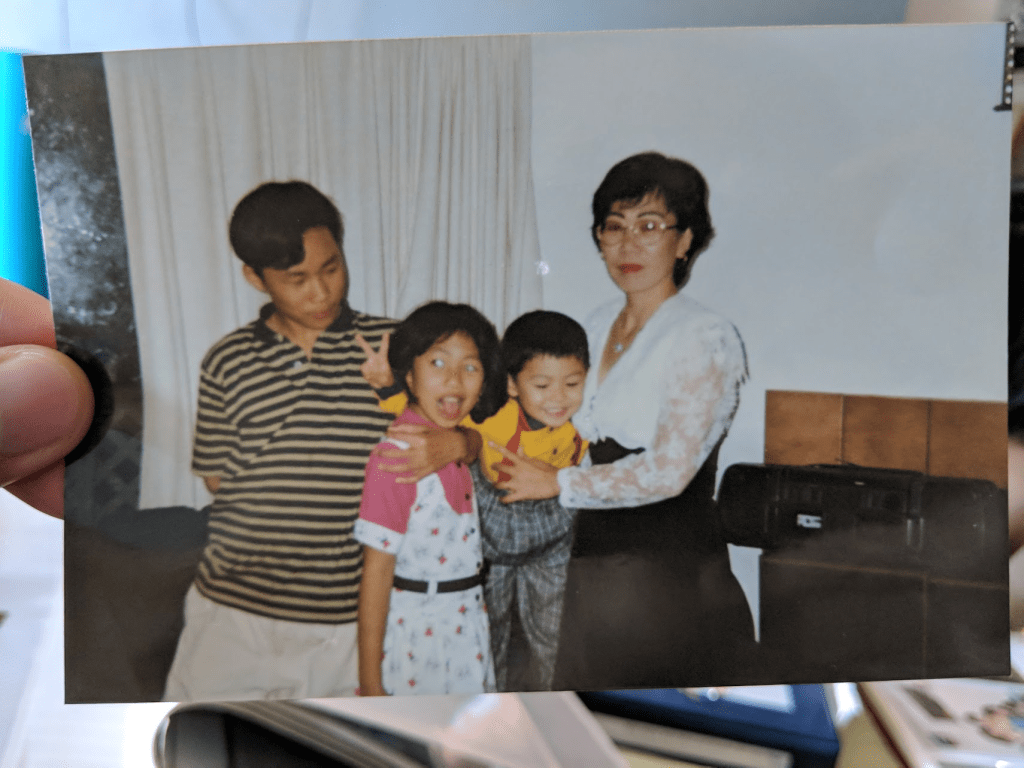
My experience growing up Vietnamese-American
But here was a common scenario I’d encounter at our larger family gatherings: an uncle would come up and say something to me in Vietnamese. I’d stare awkwardly back at them, not understanding a word.
They’d laugh and saunter off, saying something like “trời ơi, con này là người Mỹ hết rồi, không biết nói tiếng Việt đâu” (“wow, he’s full American now, he doesn’t know how to speak Vietnamese”).
Even worse, as time went on, the communication barrier with my mom began to grow. Although she had taken English classes, her English was functional at best.
I couldn’t express myself to her in the way I wanted to. I couldn’t understand what she was trying to explain to me in Vietnamese. And likewise, my mom couldn’t find the right words in English.
And as I grew older, I was beginning to think that learning Vietnamese was getting harder. “Learning Vietnamese would have been easier if I learned as a kid,” I thought.
I got older and older until eventually, I gave up on the idea of ever learning Vietnamese, and accepted that my relationship with my family was going to be this way.
Seeing life through my wife
That’s where my wife’s story comes in – she’s also Vietnamese-American.
And in her house growing up, she had to speak Vietnamese at home. Her parents don’t speak much English at all. Speaking Vietnamese was the only way they were going to communicate.
She told me stories about how she had to be the translator between her parents and her school. Just imagine an eight year old girl sitting in a classroom, having to relay messages between parent and teacher.
I sat at their dining table listening to her speak to her mom so many times, talking for hours on end, going from topic to topic.
That blew my mind, because I couldn’t imagine talking to my mom more than a few minutes without hitting that communication barrier.
I could tell that they had something intangible: a connection only accessible through shared language.
Connection through language
When I told my wife that I admired how she was able to connect with her mom, she encouraged me to speak to her mom in Vietnamese. To try, even if it was just a little.
I stumbled through the few phrases I knew in Vietnamese. She went through her basics of English: “Hello,” “Are you hungry,” and “Thank you”. We quickly ran out of things to say.
I felt that familiar frustration from before, the one I felt with my own family.
But it wasn’t until January of 2023 that I started to feel something shift. This time, the frustration didn’t translate to hopelessness. This time, I was going to do something about it.

Planning a surprise
In April 2023, we were planning to visit my family in Houston, where my parents and my brother’s family live now.
My goal was simple: After 3 months of intensive studying, I would surprise my mom with the amount of Vietnamese that I learned.
I started diving through all of the Vietnamese-learner content on YouTube that I could find. I used language exchange apps to chat with native Vietnamese speakers who wanted to learn English. I studied for hours every single day, using Anki to reinforce my vocabulary through spaced repetition. It was fun because I had my end-goal in mind, picturing my mom’s reaction.
When I got to Houston that April, she was ecstatic when she realized how good my Vietnamese had gotten. We talked a lot that week, and I got to learn a lot more about her life growing up. I felt a huge sense of relief knowing that my studying paid off.
So how’s my Vietnamese now?
These days, I call my mom every few days (something I rarely did before) to chat in Vietnamese.
I can tell that she’s been a lot happier now that we’re keeping in touch more frequently, but especially because of my effort to connect with my Vietnamese roots.
The communication barrier between us has begun to dissipate, and with it my frustrations too.
Right now, I’d say my Vietnamese is conversational enough.
I can carry a conversation properly without stumbling too much. I’ve got my pronunciation down, a decent vocabulary, and I can even nail the proper pronouns (which can be notoriously difficult in Vietnamese).
But it’s not over, because to me the journey of language learning has been better than the destination of “fluency”.
With that said, I think I’m kind of addicted to language-learning, now turning my attention to learning Japanese and Spanish. Here’s some advice I’d share with anyone before they get into learning a language, whether it’s a heritage language or a new one:

What I wish I knew before I started learning a language
Solidify your personal “Why”.
Find something to connect you to the language itself. This is more important than anything else.
When I started to feel frustrated with my language learning journey, the easiest thing for me to do was quit!
You need something that will remind you why you’re in it for the long haul.
Because honestly, it’s so much easier to be consistent when you have your goal in mind.
Remember that making mistakes is inevitable
Let go of your ego. Some people (myself included) feel like they need to get to a basic level of conversational ability before even attempting to communicate with a native speaker.
But it’s like working out a muscle group. If I’m constantly working out my legs, but never my arms, why would I expect my arms to get huge?
So if I want to get better at speaking, and I want to not be nervous when speaking the language, then I have to use the speaking muscle!
Because the ultimate function of a language is to express oneself and to understand others.
Be consistent, be patient, and have fun!
If you’re not having fun, you’re doing it wrong. Because it’s so much easier to be consistent when you are enjoying the process!
For me, I like watching travel vlogs with people talking in my target language. It makes it feel less like studying and more like entertainment.
It’s going to take time. Memory is the process of forgetting and being reminded. And in the end it’ll all be worth it.
 Kim H. Nguyen